Showing posts with label Shishir Kurup. Show all posts

Tuesday, September 29, 2015

Critical Acclaim for Disgraced

Mainstage Season opener Disgraced is making an impact on audiences and critics alike. Read what reviewers have to say about this "profound" Pulitzer Prize-winner.

Samip Raval as Abe and Rajesh Bose as Amir
The News & Observer:
“a much-needed eye-opener”
“one of PlayMakers’ most satisfying productions in several seasons”

The Daily Tar Heel:
“astounding ... a brilliant success”
“’bravo tutti’ to PlayMakers for its magnificent interpretation and presentation of a remarkably necessary artwork to the Chapel Hill and UNC communities”

INDY Week:  4 1/2 Stars:
“rewarding”
“audience members … won’t soon forget”

CVNC.org:
“powerful ... astonishing"
"most highly recommended"

Triangle Arts & Entertainment:
"brave and necessary"
“anyone, of any age, should have something to think about”

Nicole Gabriella Scipione as Emily and Rajesh Bose as Amir
And from another article in The Daily Tar Heel:
“audience members were immersed from the moment they walked in”

Playwright Ayad Akhtar tells a story that captivates, giving theatre-goers much to discuss and think about.

Experience Disgraced for yourself. Onstage through October 4th.

Click here or call the Box Office at 919-962-7529 for tickets.

Monday, September 21, 2015

Music and Identity in Disgraced: Blurred Boundaries

Sound Designer/Composer

Disgraced is a nuanced but dynamic journey through complex aspects of identity and heritage in America. Every character in the play deals with stereotypes, perception, beliefs, allegiances. For the two characters at the center of the story it is Islam and America.

Mosaic art inspiration
Director Shishir Kurup and I wanted to explore musically the complexities of this duality in the characters Amir and Emily. Both are very educated. Amir was born in America in a Pakistani Muslim family and is very critical of Islam. Emily is a white artist who uses Islam as an inspiration and some say a “subject” for her controversial art. Shishir and I realized that cultural elements should not be direct references but, rather, subtle elements mirroring the character’s psychology. Music and sound can have meaning in a variety of ways- as a reference to a place, culture, period in one’s life, or as emotional, internal and more universal. Music also allows the superimposition of distinct layers to underscore ambiguity and unresolved issues.

Nicole Gabriella Scipione on set
The music for our production has both Western elements and subtle references to Pakistan and Islam, as both characters lives are intertwined with these realities. Amir wishes to be perceived as Indian and not Pakistani (he changed his last name from Abdullah to Kapoor) and had all but renounced Islam. He is also a very driven man, full of charm, with a bit of a temper.

Stylized Bhangra beats, a traditional element in music of both India and Pakistan, are used subliminally to underscore Amir’s relationship to his heritage. Sufi melodies in filigree, represent the spiritual aspect of Islam, also present in the Punjab, and wowed in minimalist textures to underscore Emily’s Islam-inspired art. Western chamber music with a minimalist tinge, bouncy violas and cellos, represent their shared reality and success in Manhattan. Sparse piano chords underscore Emily’s state of mind as the story progress. All these elements are woven into a composed sound world that the director started using in rehearsal.

Shishir’s concept was to frame the scene by bringing the pre-show and the transitions to life as a way to share interstitial moments in the life of the characters. In those transitions the music is very present, whereas during the scenes it appears rarely and only in a very subliminal fashion.
L to R: Benjamin Curns, Rasool Jahan, Rajesh Bose and Nicole Gabriella Scipione in Disgraced
Ultimately, the final score grew out of these ideas and took shape during the technical rehearsal process, which is very collaborative, and where director, actors, set, costumes, lights and sound/music collaborate closely to sculpt and create the experience of the story.

Disgraced. Onstage now through October 4th.

Click here or call our Box Office at 919-962-7529 to reserve tickets.

Tuesday, September 15, 2015

Nephelie Andonyadis Sets the Stage for Disgraced


Alhambra art inspiration
With 20 years’ experience designing sets and costumes for Los Angeles’ Cornerstone Theater Company, South Coast Repertory and the Oregon Shakespeare Festival, among others, Nephelie Andonyadis knows what draws her to a project: a combination of intriguing, important material, an aesthetic challenge, exciting collaborators and the chance to work within the fabric of a community. With PlayMakers’ production of Disgraced,  she’s “grateful to have the opportunity to explore this remarkably insightful, challenging, and chiseled play with gifted collaborators who are dear old colleagues and new found friends.'

She and director Shishir Kurup have known each other since the early 1990s. Since then they’ve been frequent collaborators, usually in Los Angeles through shared experiences with Cornerstone Theater Company.  

She’s delighted to be at PlayMakers noting the theatre’s “wonderful” craftspeople who embrace the technical challenges of engineering and constructing every detail of the setting, as well as the impact of our strong graduate programs and the benefits of those students on the quality of work. She’s also impressed with PlayMakers’ commitment to community dialogue and efforts to create a space for meaningful conversation.

Nephelie describes her process as starting with text and action. She reads and re-reads the play, “un-structuring” the playwright’s work to find underlying stepping stones, clues and instigators for the actions that grow from the words. “My job as a designer is to imagine and create a physical, visual, aesthetic world in which the poetry and action seem perfectly surprising and inevitable. I start by building breakdowns of both the broad strokes and small details within each scene, each page. I digest the play, internalize and understand it to the point where I can imagine the space as a dynamic container for its action and poetry.” 

Nephelie's model for PlayMakers' production of Disgraced
The setting for Disgraced is the interior of a Manhattan apartment over the course of several months. There are very specific actions in the play, and moments of discovery, in which what was meant to be private is witnessed by another. Some of these are dark, ugly moments of human behavior. And therefore the geography of the set must be very particular: some actions must be hidden, while others must be revealed. Characters must see or hear, or not see or hear specific, significant moments of interaction between other characters. 
  
Another challenge is that the play was originally envisioned to be presented in a proscenium stage, with built-in mechanisms to control what is revealed and what is hidden from the audience. The PlayMakers stage is deep thrust. Nephelie describes the difference for us.

“The spatial dynamic of the Paul Greene Theatre brings the audience in close to the action, much like an ancient Greek amphitheatre (a space for dance, direct address and discourse) than like the Renaissance proscenium (a space for magic and spectacle) where the audience and performer operate facing out towards the other.” 
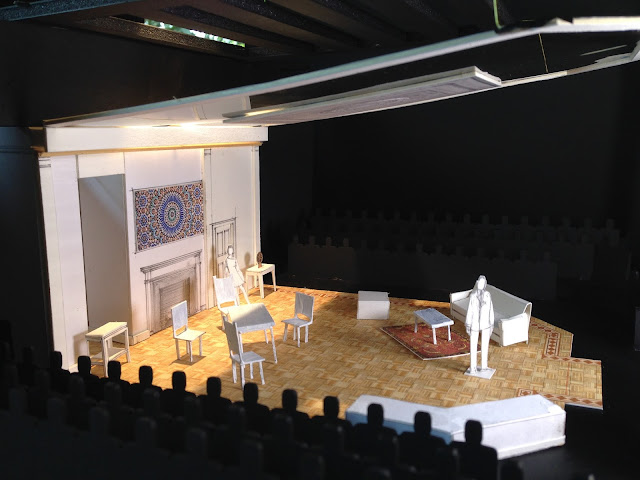
Another view of Nephelie's model for the Paul Green Theatre
But ultimately, says Nephelie, the venue shares much with the principles of the ancient amphitheatre, where attendance to see a new play was an act of citizenship as much as an opportunity for entertainment. With this in mind, the main action takes place in the central space that is the physical, visual, vocal focus of the theatre. This is where the action and characters reveal themselves and serves as the focal point for the audience, keeping attention on the key questions of the play. 

“The hope is that [our production] will entertain (it has so much humor!) while inviting audiences to see themselves, and those we imagine as ‘others,’ in a fresh way. So we begin to talk about the ways in which we Americans are all interdependent and can begin to see and be seen, to be known to ourselves and to each other. Being a part of that conversation made me want to be a part of this production.”

Join us as Disgraced brings the conversation center stage beginning September 16th.

Click here or call our Box Office at 919-962-7529 for tickets or more information.


Thursday, September 3, 2015

Director Shishir Kurup on the daring of Disgraced

“I wanted to direct Disgraced for a number of reasons, one being that it doesn’t shy away from the challenging and provocative questions of co-existence in the United States with its celebration of diversity and requisite fall out of that hybridity; namely a culture where people feel like they belong everywhere while also feeling like they belong nowhere.

“Disgraced examines what it means to be part of a culture that considers itself a free society as it pulls back the curtain on the nascent racial and cultural differences that create barriers and inequities that burble just beneath the surface of the American psyche. It looks at the clash of cultures and the misunderstandings that occur in a society that touts the notion of tolerance, and even acceptance, while also struggling to have an authentic experience of the “other,” who are constantly vying for recognition and belonging in the greater mainstream of this society.

“I admire Ayad Akhtar’s play because it dares to show a much maligned religion and culture, warts and all. It doesn’t cater to the, “there-are-so-few-stories-about-this-subject-and-our-people-so-why-not-put-our-best-face-forward" crowd. Instead, it airs the dirty laundry of Faith while being critical of false and easy liberalism; the kind that wants to see only the good that religion does, but because of ignorance of the specifics and interpretations of the Faith, acquiesces to its pitfalls. And because the ensuing championing and critique comes from unexpected sources, the audience is always having to make an assessment of what they feel even in, most likely, their own ignorance of the contents of this particular Holy Book.

Shishir Kurup
“That kind of courage is what makes the work heroic, because the critical voice emerges from within the fold. The willingness to be excoriating about the pitfalls, while also finding voice for the beauty of it—and here the author puts the beauty to test as well—and we’re left at the end with a feeling that doesn’t wrap anything tidily in a bow. And that is as it should be. After all, it’s in keeping with the likes of Miller and Ibsen in always turning the soil in order to root out the rot.

“As new cultures come up to bat in presenting their “American Dream Experience” all one need keep in mind is that telling the truth as you have come to experience it should be the unerring maxim of your art.”

Join us when Disgraced opens the Mainstage Season Sept 16-Oct 4.:

Click here or call 919-962-7529 for tickets or information.