Showing posts with label Seminar. Show all posts

Monday, October 26, 2015

Seminar Makes the Grade

The "brutally hilarious" Seminar has critics and audiences alike raving about this “bitingly funny” show.

Schuyler Scott Mastain as Douglas and Ray Dooley as Leonard
Indy Week: 4 1/2 Stars
"brilliant" “masterful”
“conveys razor-sharp lessons in a compelling master class”

The News & Observer:
“Ray Dooley in one of his most impressive roles … [shows] masterful artistry”
“highly satisfying”

The Five Points Star:
“lively entertainment”
“the ensemble sizzled”

Triangle Arts & Entertainment:
“an ideal show for a college campus”
Schuyler Scott Mastain as Douglas, Carey Cox as Kate, Ray Dooley as Leonard, Allison Altman as Izzy, and Myles Bullock as Martin
And audiences agree ...
"fun - lots of verbal fireworks"
"reminded me of my graduate school days"
“amazing actors …. such a talented company in our midst!”

Don't miss Seminar with a stellar cast led by Ray Dooley - onstage through November 1st.

Click here or call the Box Office at 919-962-7529 for tickets.

Wednesday, October 21, 2015

Seminar: Special Post-Show Conversation Sunday, Oct 25

Join PlayMakers for a post-show discussion with UNC Creative Writing faculty Daniel Wallace and Randall Kenan this Sunday, Oct 25 following the 2pm matinee performance of Seminar.

Sponsored by PlayMakers and UNC’s Creative Writing Program in the Department of English & Comparative Literature, the conversation will feature Daniel Wallace, J. Ross MacDonald Distinguished Professor of English, and Randall Kenan, Professor of English and Comparative Literature, and will be moderated by Gregory Kable, PlayMakers’ dramaturg and Senior Lecturer in the Department of Dramatic Art. Cast members from the play will also join in the discussion.

Daniel Wallace is author of four novels, including Big Fish (1998), Ray in Reverse (2000), The Watermelon King (2003) and Mr. Sebastian and the Negro Magician (2007). Big Fish was made into a motion picture of the same name by Tim Burton in 2003. Wallace has written one book for children, entitled Elynora. His illustrations have appeared in the Los Angeles Times, Italian Vanity Fair, and many other magazines and books, including Pep Talks, Warnings, and Screeds: Indispensible Wisdom and Cautionary Advice for Writers by George Singleton and Adventures in Pen Land: One Writer's Journey from Inklings to Ink by Marianne Gingher.


Randall Kenan is the author of a novel, A Visitation of Spirits; two works of non-fiction, Walking on Water: Black American Lives at the Turn of the Twenty-First Century and The Fire This Time; and a collection of stories, Let the Dead Bury Their Dead. He edited and wrote the introduction for The Cross of Redemption: The Uncollected Writings of James Baldwin. Among his awards are a Guggenheim Fellowship, the North Carolina Award, and the American Academy of Arts and Letters’ Rome Prize.


All are welcome for this special discussion - join us!

This post-show conversation is free and open to the public and will be held in the Paul Green Theatre beginning at approximately 3:50pm, 5 minutes after the end of the matinee performance of Seminar.

For information and to purchase tickets to the play, call 919-962-7529 or visit www.playmakersrep.org.

Friday, October 16, 2015

Jade Bettin Brings New York Style to Seminar


In our last post, PlayMakers resident costume designer Jade Bettin (A Midsummer Night’s Dream, The Tempest, Metamorphoses, Clybourne Park, Mary’s Wedding) described the influences that inspired her in creating clothes for Leonard and the young writers-in-progress in Seminar.

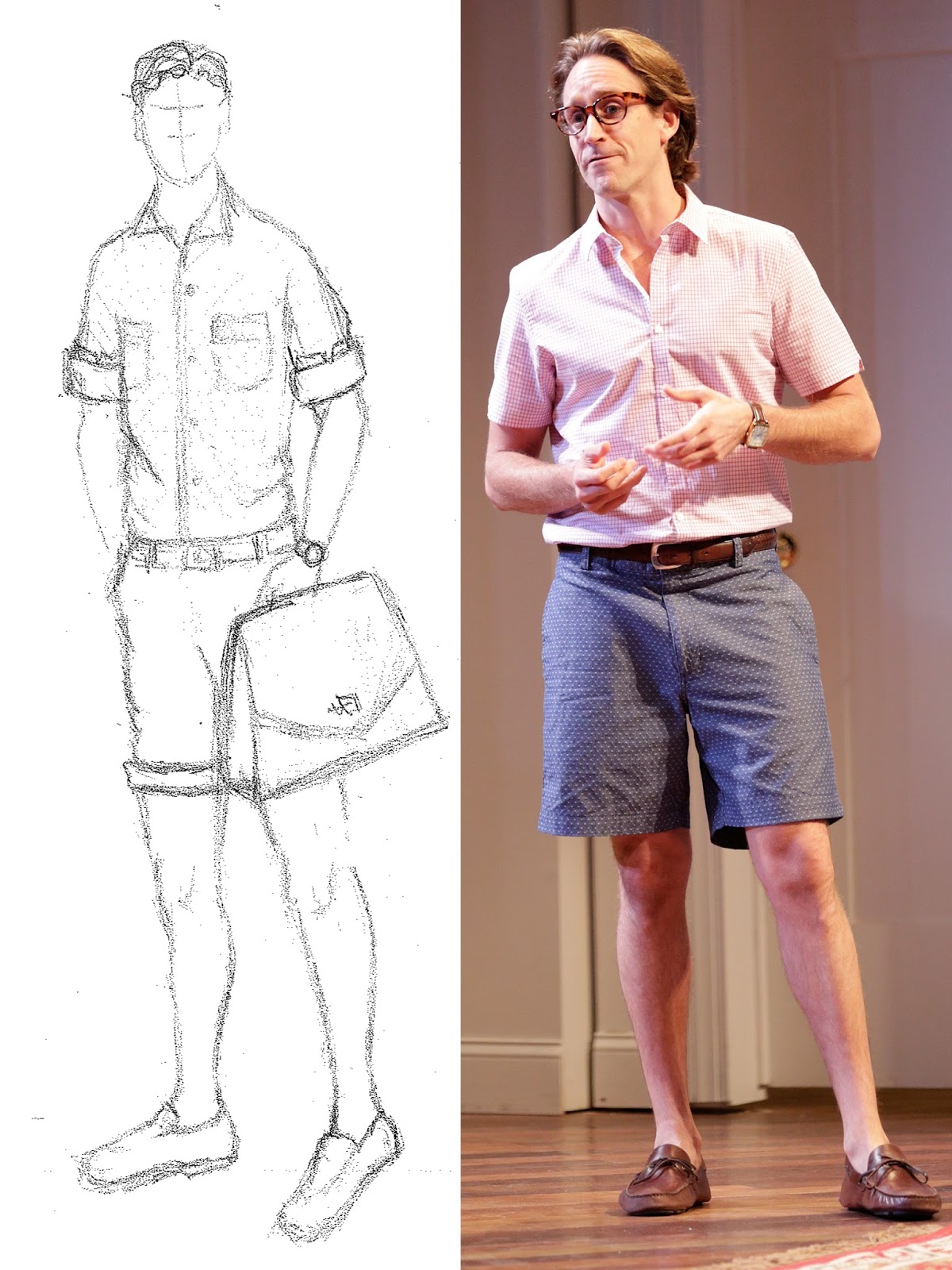
Now take a look at some of Jade’s sketches for her New York-inspired designs paired with snapshots of how they “come to life” in the production onstage.

Jade's design for Douglas, as worn by
Schuyler Scott Mastain. Photo by Jon Gardiner
Jade's design for Izzy, as worn by Allison Altman.
Photo by Jon Gardiner.

Jade's design for Leonard, as worn by Ray Dooley.
Photo by Jon Gardiner
Jade's design for Kate, as worn by Carey Cox.
Photo by Jon Gardiner.
Jade's design for Martin, as worn by Myles Bullock.
Photo by Jon Gardiner.

Join us and see how clothing contributes to the characterizations in Seminar. Onstage now through November 1st.

For tickets, Click Here or call the Box Office at 919-962-7529.

Wednesday, October 14, 2015

Presenting Identity Through Clothing in Seminar

by Jade Bettin

Costume sketch by Jade Bettin
When approaching the costume design for a play set in modern day New York City, it might seem surprising that it was the words of an ancient Greek man that would catch my attention and so perfectly capture the sentiment I was aiming for: “Know first who you are; and then adorn yourself accordingly” (Epicetus 44-135 AD). Of course this has resonance because it applies just as much to the way we approach dress today as it did then.

In Seminar, we have four young men and women, all of whom are very hopeful that their writing career is about to take off as a result of mentoring from the successful editor/writer they have hired to examine and critique their work. The students are all from different socioeconomic backgrounds, but they have in common the fact that they are all on the verge of something – they are in a state of transition and trying to find out who they are as writers and, most likely, also as individuals. My goal is to capture that state of flux in their clothes as they try to sort out who they are.

Kate's clothing
To go back to Epicetus’ quote, because these students are still figuring out who they are, what they present of themselves through their clothing are works in progress. So, what messages are their clothes sending and what does it reveal about them in that moment? Each of these students bravely presents their written work to Leonard and it is clear after his critique of Kate’s story in the second scene that they are going to get the brutal truth. And so they are arming themselves for these encounters; putting their best foot forward as we might do for an important interview or date. They are largely doing that with the clothes they wear. For Kate, it’s about putting on her best dress and curling her hair just so. For Douglas, it’s about the costume he imagines a successful writer would wear. This is not necessarily their true selves, but their best selves, or in some cases, the selves they hope they become as a result of these seminar sessions.


I am fortunate in that I get to tell this story of the characters’ identity over the course of the play as there are nine scenes and in nearly every scene the characters wear different clothes. For instance, I am able to explore the fallout of Leonard’s critique on Kate through her clothing. The clothes she wears in the middle section of the play are probably a closer reflection of who Kate actually is at that moment. Just as she needs Leonard to challenge her writing and jar her out of complacency, she needs those revelations about self so that she can discover who she is and dress accordingly.

Join us to see how these young writers evolve, as Seminar takes the stage tonight through November 1st.

Click here or call our Box Office at 919-962-7529 for tickets.

Monday, October 12, 2015

Seminar: Let's Be Brutally Honest

by Adam Versényi

Theresa Rebeck’s Seminar, with its conversation surrounding mentorship and education is, in many ways, the perfect play for production by a theatre company like PlayMakers located on a university campus. That conversation is even more relevant when it quickly becomes clear that the seminar in question is concerned with creative writing, a discipline with a long strong history on the UNC campus. The South is a region known for the strength of its fiction writers, many nurtured by programs like ours here in Chapel Hill.


Rebeck’s biting comedy is set in a New York City Upper West Side apartment where four young writers gather for a master class taught by Leonard, once a young fiction phenom himself, who is now a highly sought after editor and a journalist covering war-torn, strife-ridden areas of the globe in the style of Christopher Hedges or C.J. Shivers. The old lion Leonard circles and snipes, pokes and prods, insults and incites the young feral cats that are his charges. In the process, Rebeck explores these writers and all of our life-long cycle of self-identification. The question at the root of this seminar is not so much what it takes to be an artist, but more provocatively, what it takes to be a human being. Rebeck’s characters expose themselves to one another and to us, moving in and out of states of vulnerability and rawness, struggling with how the nature of authenticity contrasts with the perception of authenticity.

Perhaps the central vehicle Rebeck uses to explore these questions is the various shades of honesty we encounter in the play. Like us all, her characters are honest with one another in different degrees, at different times. Leonard’s teaching technique of brutal honesty with his students motivates a great deal of the play’s dramatic action, but also raises questions. Is he being truly honest, both with them and with himself? And is brutal honesty, the tearing down of a student in order to build her or him up again, an effective teaching technique, or simply an exercise of power, an unadulterated ego-trip? Through her characters Rebeck allows us to come to different conclusions in answer to these questions as Leonard and the young writers explore nature vs. nurture, the quality of experience vs. innate identity, as they work to become the type of artist they want to be. The feral cats act on instinct while the old lion offers sage advice gained on the killing fields of the savannah. Rebeck’s play is certainly full of witty dialogue, but it is much more than people sitting around pontificating. This is a muscular, active experience for the audience member. Pull up your chair for this Seminar; join the debate.

Seminar is onstage beginning October 14th.

Click here or call our Box Office at 919-962-7529 for tickets.

Friday, October 9, 2015

Ray Dooley: Finding and Becoming Leonard in Seminar

Ray Dooley as Leonard
In Seminar, Ray Dooley plays the ruthless and frank character of Leonard, a writer/editor who conducts private seminars with young writers looking for both expert criticism and connections to the field of publishing. "Leonard's brain moves so quickly that one sentence can last the better part of a minute. His mind is continually turning over new images and thoughts, and new thoughts are pushing the previous thought out of the way as he strives to make his point the most effective way he can," says Ray, describing how Leonard's grammar is connective and that learning it requires intuitive leaps, one of the largest challenges of playing the role.

With a cast of five, the play "adheres to the unities of time, space and action" more closely than some other productions. The scenes lead to a final showdown, which creates a tighter and smaller canvas. Leonard is moving on a straight line towards an climactic encounter, which is easier to get one's mind around, "but just as a sonata or a quartet, it's not necessarily easier to play." Ray says that although it's different, it's more focused, and in some ways more demanding.

Through a series of metaphorical exercises led by director Michael Dove, Ray was able to uncover the underpinnings of each scene and the skeleton beneath the surface which provided structure to the action.
"Near the end of the play, I have a long speech where I am including one of the young writers in a pointed and emphatic critique of his life, my life and the writing profession. Myles [Bullock], the actor playing the young writer, in order to 'protect' himself, started building a wall around me with chairs. It became that he was putting me in a prison so that I couldn’t get to him with my critique and attack. At the end of the speech, what happens in the play is that my character leaves his character in a very exposed and bleak position. As I got near the end of that speech, I walked around, took him by the hand, walked him into the prison he had created, and as I finished the speech, I close the door on him. We had a visual metaphor of what my character had, in essence, done to his character, leaving him locked in a prison of his own creation. It was a beautiful visualization of that moment."
The four actors playing the writing students in PlayMakers' production are actually Ray's students in UNC's Professional Actor Training Program. "There's always extra pressure when you are working without a net with your own students." He describes the pressure to practice what he preaches, as they can see whether or not he's applying the things taught in the studio. "It's also a great joy when I see these early career professionals doing so well," says Ray.

When creating the wardrobe for Leonard, Ray and Jade Bettin, costume designer for Seminar, drew closely from real life models. "There's an actor in New York I admire greatly, who has some similarities to Leonard." To some degree, they based the wardrobe on that real life person's clothing choices, found in professional and candid photos. "When an actor is building belief in a character, it's a great help to know that these are looks that actually work in real life." The duo also considered where Leonard had just come from and where he is going. In doing that, Ray is able to build a backstory for the earlier portion of the day, which may or may not have gone well.

In terms of set, scenic designer Robin Vest has built a sunken living room downstage, close to the audience, where the first two seminar sessions take place. This allows for a more personal, intimate setting, whereas if the play were upstage, "we would have to try to open it out to the audience, almost as if we were playing in a proscenium house, and probably not able to play quite so intimately." Ray says that playing downstage allows the cast to "paint with fine brushes" rather than having to be sure the audience can hear and see them, allowing the cast more flexibility.

Ray feels it has been a rare privilege to be a part of PlayMakers for so long. Being at PlayMakers is the job Ray says he trained for in the 1970s at the American Conservatory Theatre in San Francisco. "Among the greatest joys are my colleagues." Ray describes the role of Leonard as a parting gift from former Producing Artistic Director Joseph Haj and calls working with director Michael Dove "a joy." "It's an extraordinary company of people, and in many ways, a family. We have become the fabric of each other's lives and it shows in the work on stage."

"I certainly get inspiration from the audience here; the audience and I have a 26-year relationship now-and that’s a great privilege. I try to live up to that every time I step on stage and try to live up to the responsibility and the implicit promise every time." 
- Ray Dooley

Seminar takes the stage October 14th through November 1st.

Click here or call our Box Office at 919-962-7529 for tickets.

Monday, October 5, 2015

What We Can Learn Through Seminar

Michael Dove, Director of Seminar

Michael Dove, founding Artistic Director of Forum Theatre in Washington, DC and winner of three Helen Hayes Awards, makes his PlayMakers debut directing Seminar. Michael says, "the thing I most often find myself thinking about in rehearsals for this play is how painfully difficult it is to know yourself."
 Life is complicated. People are complicated. If you can’t figure that out, you’ll never be much of a writer.
Seminar
"Isn't that the truth!" agrees Michael.

When he heard that neurologist and writer Oliver Sacks had died, Michael found himself obsessed with reading Sacks' writings, realizing that no new words would be coming from him again. Sacks' explorations and discoveries helped shape how Michael sees the world, and understanding the self became the soundtrack to his experience with the bitingly funny Seminar. "It's become a dramatization of Sacks' ideas and questions for me... a play about passion and discovering who you truly are."

In Seminar, four young writers enroll in a private class taught by Leonard, a renowned novelist/editor (played by Ray Dooley). Leonard only has time for the truth, unfiltered. His unorthodox methods put their fragile, developing egos on the cutting board and bring their ferocious envy to the forefront. "Here are four young writers all struggling with the ability to perceive themselves and to find their true voice coupled with a mentor whose tough exterior protects the wounded artistic soul inside," says Michael.
To me, the most compelling stories are the ones that are complicated. The brilliant writers are the ones that try to tackle all the contradictions ‪in our world, all the complexities of relationships, all the differings of opinions, all the nuances of a culture within the confines of the page. The best short stories, novels, plays take all that chaos and help you, the reader or watcher, better understand the human condition.
- Michael Dove
Michael says the beauty of Seminar is how it infuses toil and difficulty with humor. Actor Alan Rickman, who originated the role of Leonard on Broadway, described the play as a "comedy of very bad manners."

"Everyone struggles everyday to find their true self and purity," continues Michael, making Seminar a relatable comedy. "Insecurities, pain... how can we not laugh at that."

"Some of the richest stories of our lives are the traumatic academic experience or pangs of heartache that make it up. The characters [in Seminar] combat with 'such animalistic ferocity' that makes for wickedly funny and clever theatre."

"I have long admired the work at PlayMakers and can’t wait to share the pleasure of watching the amazing Ray Dooley with you all as he takes on the role of Leonard. This is one of the smartest comedies to come out of the American Theatre in the last five years, and I am thrilled to share it with this community."


Join director Michael Dove and his creative team for Seminar. Onstage Oct 14 - Nov 1.

Click here or call the Box Office at 919-962-7529 for tickets.

Thursday, May 14, 2015

2015/16 Season Preview and Q&A with Joseph Haj


On June 11th at 6:30pm we’re hosting a special preview of the upcoming season including a Q&A with Producing Artistic Director Joseph Haj. WUNC’s Frank Stasio will join Joe onstage to discuss the 2015/16 lineup and what’s ahead for PlayMakers. It will be an evening of celebration for our PlayMakers family and the community.

As a prelude to our June 11th event, Joe sat down for an interview with PlayMakers dramaturg Jacqueline Lawton to discuss how he selects a season and what excites him about our new slate of plays. He also shares a few thoughts on his time at PlayMakers.

Read on for highlights from their conversation; then we hope you’ll join us on June 11th for more of Joe’s insider look at the road ahead and the chance to pose some of your own questions.

This event is FREE, but reservations are required, first come, first served, as space is limited. Please contact the Box Office at 919.962.7529 to reserve your spot today!

Click here for June 11th event details.


A conversation with Producing Artistic Director Joseph Haj & Dramaturg Jacqueline Lawton


Jacqueline Lawton (JL): What guides you when selecting a season? 

Joseph Haj (JH): A season ought to feel like a multi-course meal. If it’s all dessert, that’s no good. If it’s all meat, that’s no good either. Like any good meal, there’s a salad, a first course, an entrée, and, of course, dessert and coffee. We proportion the menu with a variety of dishes - larger to smaller cast shows, larger to smaller productions. We also want to give ample opportunities to our company – our resident acting company as well as the graduate students in technical and costume production. So, for instance, we ask - is there a play in period in the season? The students can’t just put jeans and t-shirts on characters all season long. There must be a variety of styles and approaches for educational purposes, along with providing variety onstage. So you see many factors are involved. But to answer the question narrowly, we choose a pattern of plays that make us sit up and say “THIS … this is the season we want to make.”

JL: The 2015/16 Mainstage Season opener is Disgraced by Ayad Akhtar. Why did you want to produce this play?

JH: I went with my family to visit my wife’s parents in South Carolina and Disgraced was one of several scripts I read over the weekend. I finished reading and was so disturbed by it. And all the other plays all kind of vanished. All I could think about was this complicated, atypical, challenging play. It caused me to think about ideas around, not just racial prejudice, but cultural assimilation. Anything that had me thinking for so long and so deeply about these important questions had to be a part of the season.

JL: Next in the lineup is Seminar by Theresa Rebeck. Why do you feel Seminar will resonate so well here? 

JH: I love this play particularly in our world here, as a professional theatre on a university campus. The play deals with the dynamic of a brilliant, complicated teacher and four students, who pay a fair amount of money to be close to his genius and learn about writing. It says an awful lot about the dynamic between teachers and students, and the way we make heroes and knock them down. It also lines up beautifully for the magnificent actor, Ray Dooley, in the central role of the teacher, and four members of our acting company as the students.

JL: Then you selected Peter and the Starcatcher for the holidays. 

JH: I wanted a family show for the holiday season, but the challenge is to find something that’s thrilling, fun, beautifully crafted, and not just for kids. So, I’m very excited about Peter and the Starcatcher because it truly resonates on an adult level as well as with young people. It’s an absolute delight, filled with invention and will feature 13-14 members of our acting company. Brendon Fox, who led terrific productions of Opus and Angels in America at PlayMakers, will be directing for us.

JL: Following that, we have the world premiere of a new adaptation of Anton Chekhov’s Three Sisters. 

JH: Libby Appel, former artistic director of the Oregon Shakespeare Festival, is one of our great Chekhov scholars, translators, adaptors, and I love her new version of Three Sisters. I love her point of view. It’s smart and muscular. It’s not pulled out of period in any way, yet it feels contemporary in a way that feels close to us. To see Anton Chekhov’s great text through the lens of Libby’s expertise made me excited to do this play. And with a wonderful director like Vivienne Benesch, who’s been with us on multiple occasions (Red, In the Next Room, Love Alone), it will be in good hands.

JL: From there, we have We Are Proud to Present… by Jackie Sibblies Drury. What draws you to this play? 

JH: I love this play. I love it formally. I love it aesthetically. I love its politics. A group of well-minded, well-intentioned folks get together to try to put on a play - which is something ludicrously hard to do under the best of circumstances. Then, in their exploration of the topics in the play, the wheels come off, which ends up being terrifically revealing about the undercurrents of prejudice that reside even in those of us who consider ourselves progressive. The play illuminates these ideas in insightful ways in the form of a very exciting piece of theatre. We Are Proud to Present… will be directed by Desdemona Chiang, who so beautifully helmed this season’s Mainstage finale, 4000 Miles.

JL: Tell us about the Mainstage Season finale, Stephen Sondheim’s Sweeney Todd

JH: Sondheim is hands-down one of our great playwrights; and Sweeney Todd, which is almost entirely sung, is a masterpiece. A revenge story, it’s set against the meat grinder of the Industrial Revolution. This idea of the meat grinder – in the story there are people ground into pies – is a metaphor for a society grinding its own citizens into the dust. With themes of economic disparity, it speaks to our current moment in a lot of ways. I’m thrilled to have it in the season as another look at the masterworks of Stephen Sondheim, as last season featured Into the Woods.

JL: Why did you chose Uncle Ho to Uncle Sam and Highway 47 for the PRC2 second stage series?

JH: Uncle Ho to Uncle Sam follows the harrowing journey of Trieu Tran and his family from Vietnam to the United States. It’s a profound immigrant story. KJ Sanchez’s Highway 47 is another story about the American experience. KJ can track her ancestry in New Mexico back at least a dozen generations through the land given to her family through Spanish land grants. The play is about enormous battles in her family for the rights to that land. KJ is both writer and performer; as is Trieu Tran of his play.

JL: Being located in the Triangle area of North Carolina and based on a university campus, there’s a wide range of cultures, racial and gender identities, religions in our community. Can you talk about the efforts that go into making sure those communities are represented onstage in the plays and off stage in the audience? 

JH: It’s an enormous challenge. Universities are often seen as ivory towers in their broader community. And theatres, institutional theatres, are often thought of in the same way. So when you’re a professional theatre housed on a university campus, you’re talking about an ivory tower inside an ivory tower in terms of perception. We’ve worked very, very, very hard over these last nine years to make the walls of the building more porous. To offer a broader sense of invitation – to really make clear that all of our community is welcome and desired to be part of our theatre.

JL: Share with us how you work to bring greater inclusion to theatre. 

JH: The leader of an organization needs to determine whether diversity is a priority. And if it is, then you must be intentional about what you’re doing, at least some of the time. We work hard to make sure there’s inclusion of a diversity of voices across the season in terms of the work that we do. It’s a challenge when you’re a theatre dedicated to the classics, but there are ways, such as determining who gets to tell those stories, who are the directors and do you have gender and ethnic balance amongst those directors and who will design the plays. We’re very intentional about having a plurality of voices; different points of view. And not as a matter of checking boxes, but because we believe it actually makes the art better.

JL: Allow me to express a heartfelt congrats from all of us at PlayMakers on your appointment as the Guthrie Theater’s next Artistic Director. You’ve achieved so much during your tenure here. What do you feel most proud of? 

JH: Thank you. It has been an honor to serve this community. I’m proud that we’ve built an audience, a community of people, who are interested in their own growth through participation in the life of a professional theatre. That’s a beautiful gift, and I’ll miss that entirely. We have an audience who comes not only to be entertained, to have a laugh or see a show that may be forgotten by morning. Our audience members are also interested in testing themselves … testing their ideas and their ideas about themselves. And that’s been built over time. When I came here nine years ago, we were a theatre making five plays a year. And I thought of something Ben Cameron, head of TCG [Theatre Communications Group], used to say. Ben said, “A good question for an arts organization to ask itself is what would be lost from the community if it were to shutter its doors?” I firmly held that question in mind when I started here. I remember thinking, if the answer is only five well-made plays a year, then that wouldn’t be nearly enough. That’s not nearly an important enough role for a regional theatre. I think PlayMakers has become an important part of the cultural fabric of this community. And for that, I’m very proud.

JL: And finally, what do you think you’ll miss the most? 

JH: The greatest gift an artistic director can be given is the opportunity to make work for smart people; and we have an incredibly smart community here. Many patrons come to us as sophisticated theatre-goers and many more have become sophisticated theatre-goers by virtue of participating in our work. I’ll miss that a lot. Fortunately I’m going to the Guthrie, and the Twin Cities, an area also noted for supporting of the arts. I’m incredibly grateful for the support of this community and for what we’ve achieved at PlayMakers.

Join us on June 11th for our FREE 2015/16 Season Preview event and Q&A with Joseph Haj. Reservations are required as space is limited, so call our Box Office at 919.962.7529 to reserve your spot!