Showing posts with label sets. Show all posts

Tuesday, November 10, 2015

Scenic Designer McKay Coble: Making a Magical Neverland

Through her intricate design of Neverland, scenic designer McKay Coble aims to transport the audience back to their childhood where magic feeds off itself and imagination. She wants to remind adults what it was like to be an imaginative kid and create something complicated out of nothing. "I want them to look at the set and go 'Oh, I had a tree house like that, I had a fort. I’ve picked up a switch, and it was a sword.'"

Source: My Modern Met: The ultimate children's pirate bedroom
The design process was much different for this play. McKay first began by looking for common denominators in how children envision and imagine becoming a pirate. "I started looking at treehouses, ropes, ships and all the elements that going into the imaginative world where one might be a pirate. I also looked at found object art where you’re holding a spade and suddenly it becomes a bird."

Sometimes a draft is made, then a model is built. In this production, sketching and modeling were done at the same time since the play is so active. With a large company of 13 cast members, all of whom are constantly doing something, McKay worked closely with the rest of the team to create actions on top of each other and build a world where anything can happen.
"I wanted this set to do a lot of things. It has mermaids, flying, birds, and cats; it has one of everything. The play has lots of opportunities for special effects, and that's a challenge. The set has tons of props and it does everything- it spins and it flips. The technology PlayMakers has sets it apart from the other places where I’ve designed. The technology that we practice and teach is probably some of the best in the country. Our production shops are not afraid to do anything, and they can do anything. We challenge one another and stretch our abilities. There’s very little I can think of that they can't do, so I’m not limited. I can think about people flying and magic without having to worry that we can’t do it- because I know we can."
From right to left: Source: Hub Pages, unforgettable tree houses; Enchanted Forest BC; McKay's sketch of the set

When McKay, who loves the story of Peter Pan, heard that Brendon Fox was directing, she knew she wanted to be a part of this production. "[Brendon] has a mind that runs 500 miles an hour and it's invigorating. Sometimes it feels like you're on a runaway train, but you're always headed in an imaginative direction." McKay says one of the best parts of working with Brendon is that he doesn't come into a show with any preconceived ideas; he works with the team so that one idea triggers another.

Source: Arthur Rackham's "Peter Pan in Kensington Gardens"
She and Brendon worked closely together while designing the set, looking at many of Chris Van Allsburg's books, as well as illustrations from Barrie's Peter Pan in Kensington Gardens. This research manifests its oldness in the set indirectly. "I can look at the original work by J.M. Barrie and a million images of Neverland, but for me it's not about that Peter Pan, it's about how he becomes Peter Pan."

To McKay, this is the highlight of our production - the collaborative effort and imagination of the team in creating her vision of how Peter Pan comes to be. "It's the kind of piece where everybody puts out ideas whether they have to do with their particular niche or not and everything works together through constant communication."


Bring a sense of wonder and imagination and join us for Peter and the Starcatcher November 18 - December 12.

Click here or call our Box Office at 919-962-7529 for tickets.

Tuesday, September 15, 2015

Nephelie Andonyadis Sets the Stage for Disgraced


Alhambra art inspiration
With 20 years’ experience designing sets and costumes for Los Angeles’ Cornerstone Theater Company, South Coast Repertory and the Oregon Shakespeare Festival, among others, Nephelie Andonyadis knows what draws her to a project: a combination of intriguing, important material, an aesthetic challenge, exciting collaborators and the chance to work within the fabric of a community. With PlayMakers’ production of Disgraced,  she’s “grateful to have the opportunity to explore this remarkably insightful, challenging, and chiseled play with gifted collaborators who are dear old colleagues and new found friends.'

She and director Shishir Kurup have known each other since the early 1990s. Since then they’ve been frequent collaborators, usually in Los Angeles through shared experiences with Cornerstone Theater Company.  

She’s delighted to be at PlayMakers noting the theatre’s “wonderful” craftspeople who embrace the technical challenges of engineering and constructing every detail of the setting, as well as the impact of our strong graduate programs and the benefits of those students on the quality of work. She’s also impressed with PlayMakers’ commitment to community dialogue and efforts to create a space for meaningful conversation.

Nephelie describes her process as starting with text and action. She reads and re-reads the play, “un-structuring” the playwright’s work to find underlying stepping stones, clues and instigators for the actions that grow from the words. “My job as a designer is to imagine and create a physical, visual, aesthetic world in which the poetry and action seem perfectly surprising and inevitable. I start by building breakdowns of both the broad strokes and small details within each scene, each page. I digest the play, internalize and understand it to the point where I can imagine the space as a dynamic container for its action and poetry.” 

Nephelie's model for PlayMakers' production of Disgraced
The setting for Disgraced is the interior of a Manhattan apartment over the course of several months. There are very specific actions in the play, and moments of discovery, in which what was meant to be private is witnessed by another. Some of these are dark, ugly moments of human behavior. And therefore the geography of the set must be very particular: some actions must be hidden, while others must be revealed. Characters must see or hear, or not see or hear specific, significant moments of interaction between other characters. 
  
Another challenge is that the play was originally envisioned to be presented in a proscenium stage, with built-in mechanisms to control what is revealed and what is hidden from the audience. The PlayMakers stage is deep thrust. Nephelie describes the difference for us.

“The spatial dynamic of the Paul Greene Theatre brings the audience in close to the action, much like an ancient Greek amphitheatre (a space for dance, direct address and discourse) than like the Renaissance proscenium (a space for magic and spectacle) where the audience and performer operate facing out towards the other.” 

Another view of Nephelie's model for the Paul Green Theatre
But ultimately, says Nephelie, the venue shares much with the principles of the ancient amphitheatre, where attendance to see a new play was an act of citizenship as much as an opportunity for entertainment. With this in mind, the main action takes place in the central space that is the physical, visual, vocal focus of the theatre. This is where the action and characters reveal themselves and serves as the focal point for the audience, keeping attention on the key questions of the play. 

“The hope is that [our production] will entertain (it has so much humor!) while inviting audiences to see themselves, and those we imagine as ‘others,’ in a fresh way. So we begin to talk about the ways in which we Americans are all interdependent and can begin to see and be seen, to be known to ourselves and to each other. Being a part of that conversation made me want to be a part of this production.”

Join us as Disgraced brings the conversation center stage beginning September 16th.

Click here or call our Box Office at 919-962-7529 for tickets or more information.


Monday, July 6, 2015

A New Look at an Iconic Musical: Robin Vest’s Scenic Design for Guys & Dolls

Scenic designer Robin Vest returns to PlayMakers to create the set for Guys & Dolls. She’s an SYC veteran, having designed last summer’s colorful take on 1960s Baltimore for Hairspray. Her other designs for PlayMakers include the sets for A Raisin in the Sun/Clybourne Park and Shipwrecked! An Entertainment.

Robin says “The most exciting thing about designing this Guys & Dolls is that director Jeff Meanza chose to set it in the 1930s, when the original stories on which the show is based were written. This really gave me an opportunity to re-invent the Paul Green Theatre and forget my preconceived notions of a bright graphic 1940s-50s set (the period the musical debuted on Broadway).

“I started by looking at photos of Times Square in the 1930s and Bernice Abbott's book Changing New York, a collection of photos of all the neighborhoods of Manhattan, taken in the late 1930s for the WPA (FDR’s Works Project Administration).

“New York was a bustling place in the 1930s, but the spectacle of Times Square looks seedier. There's less neon with more signs made of light bulbs. I was also taken with the fact that there were American flags hanging from the lampposts up and down the streets surrounding Times Square. The Great Depression was a very patriotic time. We were choosing not to enter the war brewing in Europe and put our energies on healing the country.


“I needed a sort of glue to hold all these ideas together in the theatre space and that became the image of “the subway.” I started with the wall upstage housing the band being modeled after details of a subway car. Then, when I was looking for inspiration for the floor the 1939 subway map followed.

“We set out to make a collage effect that reflects the story, the time, and the energy of 1930s Broadway. When we go to specific locations in the play, such as The Hot Box Club or Havana, we light up signs or add small pieces, we don't do big changes.

“Anything can happen in New York. At any moment you can be anyone or find yourself somewhere new.”

Join us to experience our new look at Guys & Dolls - onstage July 15-25.

Click here for tickets or more information or call our Box Office at 919.962.7529.

Tuesday, April 21, 2015

Director Cody Nickell on imagining his "dream play," Mary's Wedding


In Mary's Wedding by Stephen Massicotte, two actors come together to create a dream sequence taking us through horse rides, battle scenes and tea parties that ultimately lead to the blossoming of their love. The character Charlie first addresses the audience and makes it perfectly clear that the events to follow are part of a dream. "I ask you to remember that," he says. Director Cody Nickell says the dreamlike setting allows the production to break all rules of time, space, and at times, even character.

Cody had many difficult questions to answer at the start of the production process. The dream moves from place to place quickly, leaving complicated theatrical elements for Cody to consider. While some may see these questions as challenges, Cody chooses to see them as gifts.
"How do you bring to life a horse for a cavalry charge when there is no horse? How do you show a moonlit battle between trenches on the front lines of World War I with only two actors? And maybe most interesting, for all its theatricality, how do you show the simple story at the heart of this play about two young people falling in love?"
While the staging can be difficult, the underlying story of Mary's Wedding is much simpler. It follows the relationship of two young people in love and the Great War that comes between them. To escape a thunderstorm, Charlie, played by Myles Bullock, and Mary, played by Carey Cox, seek shelter in an old barn. In this setting, their vulnerabilities are exposed and we see sparks of love develop between them almost immediately. The audience follows their budding romance, and ultimately, their separation when Charlie is taken off to war.
"It begins at the end and ends at the beginning. There are sad parts. Don’t let that stop you from dreaming it too. " - Charlie, in his first monologue from Mary's Wedding.
The many imaginative gifts the production staff conjures will awaken the imaginations of audience members as well. "This engagement of audience imagination makes the experience active for them, not passive; they become witnesses, not just observers," says Cody. The actors are on a journey, but they invite the audience along to experience the terror and the hope that Charlie and Mary encounter.

Jeff Adelberg's mystic skyscapes and lighting will be a key factor in the quickly changing time, place and mood of the dream sequence. And Cody says costume designer Jade Bettin took initial costume ideas and ran with them, doing spectacular research and paying attention to details that further conceptualize the journey both the actors and audience traverse. Jeff's lighting paired with Jade's period costumes will pique imaginations and transform the stage from a physical space, to a fantastical world with no limits.

Cody says he's thrilled to collaborate with scenic designer Daniel Conway once again. Daniel's set has a circular frame creating a portal through which the audience views the story. This portal takes us from Canadian plains to European battlefields on a dynamic set that will evoke the many settings explored by the young lovers.

Experience the dream of Mary's Wedding with us April 29th to May 3rd!

Click here for more information or call our box office at 919.962.7529.

Tuesday, March 3, 2015

Cohesive Contrasts: A Closer Look at McKay Coble's Scenic Design for An Enemy of the People

An  early sketch of McKay's design.
An Enemy of the People takes place in a Norwegian town circa 1950. McKay Coble's scenic design puts the audience directly in this specific setting by utilizing contrasts between a stark, industrial water feature and an inviting family home.

In order to reflect the action of the play, her design incorporates muted greys alongside brighter colors to symbolize the pessimistic versus the optimistic. On one hand there's the idealistic Dr. Stockmann, morally prepared to do the right thing. On the other is his brother, Peter, repressing the truth for the sake of money and self-interest.

McKay explains, "There's this nugget of idealism with Dr. Stockmann and his family, which I've tried to portray as a sunny, warm, cohesive environment where everything fits together. Their comfortable home contrasts with a grey outside world that threatens to fall apart at any moment."

The Stockmanns' charming 1950s home. Photo by Curtis Brown.
McKay's aim is to create a space in which truth can unfold. Her detailed design allows the actors to discover their reality. And, as always, she's gone above and beyond, fine tuning to be accurate to the time period and support the work of the ensemble onstage.

Look for childhood photos of cast members adapted to fit the era, and notepads, not left blank, but filled with stories to keep the actors engaged in their craft! Details like this are indicative of McKay's meticulous approach to design and her ability to give the actors a realistic space to create, discover, and live in the moment.

Some truly remarkable elements of McKay's scenic design are the set transforms as plot and characters evolve. A monumental transition occurs when the Stockmanns' cozy living room fades into the background and a newspaper office rises to become the focal point. This transition parallels the shift of public opinion away from Dr. Stockmann and in favor of his conniving but impeccably dressed brother, Peter.

The transition from the Stockmann home to the newspaper office. Pictured: Benjamin Curns and Gregory DeCandia. Photo by Curtis Brown.
The water feature surrounding the Stockmanns' home proves to be a stand-out piece of the production. Because water is so integral to the plot, McKay felt it was a necessity to the scenic design. And the moat-like segment of the set is not just there for looks, it serves an important purpose. When the action shifts away from the Stockmanns' home to the office of the town newspaper water begins to fall from piping in the ceiling, changing the mood of the play from happy-go-lucky to ominous and eerie, causing the audience to question what's to come.

Just as his brother, the newspaper, and the townspeople turn on Dr. Stockmann, so does the water. Following a one-sided debate, Dr. Stockmann is bombarded by an unsavory crowd that removes grates from the edge of the set, scoops water from the trough, and throws it in his face. This moment in the play serves as a snapshot of the troubles yet to come for the Stockmann family.

McKay felt the water could represent the truth that's being kept hidden from the townspeople. She explained, "The truth could not be contained, just as the water could not be contained."

The mob entering the Stockmann home. Photo by Curtis Brown.
The feasibility of destroying set pieces presented a challenge to McKay. Once Peter announces that Dr. Stockmann is to be labeled "an enemy of the people," the unrelenting mob takes its aggression out on the Stockmann home. They enter with weapons, and when they're done what was once the safe nest of this loving family appears leveled and torn apart. McKay's design set the stage as the actors embody a whirlwind of destruction, creating a shocking scene that propels the story to climatic heights.

See McKay Coble's fantastic set for yourself. Book your tickets for An Enemy of the People - onstage through March 15!

Click here for more info or call our box office at 919.962.7529.


Friday, February 20, 2015

Director Tom Quaintance on creating a true "Enemy of the People"

Tom Quaintance, director
Although An Enemy of the People was written by Henrik Ibsen in 1882 and adapted by Arthur Miller in the 1950s, director Tom Quaintance believes it is as relevant today as it was for those eras. With characters that grapple with corruption, the influence of money, and the power of the media to shape public opinion, Tom says this play "feels like it could have been written yesterday."

The plot follows Dr. Stockmann, played by Michael Bryan French, who tries to alert citizens when he discovers an underwater spring feeding the successful town spa is threatened by toxic waste poisoning. His brother Peter, played by Anthony Newfield, serves as Chairman of the Board of the spa. He works against his brother, feeling it's in the town's best interest to conceal Dr. Stockmann's findings.

In our current age of leaders with questionable ethics, nonstop surveillance, and unverified media sources, the story of Dr. Stockmann could not be more pertinent. Tom explains:
"It is the story of science versus politics. It is the story of a whistleblower. It is the story of how money influences everything. It is the story of how the media shapes how we view the world. In today’s increasingly divided society, where people increasingly only hear the news and the spin they want to hear, it is an important play."
With the show holding many themes, Tom has collaborated with scenic designer McKay Coble and costume designer Patrick Holt to create a production that evokes the truth and realism Arthur Miller sought to portray when adapting the play.
McKay Coble's scenic design model

Tom describes the costumes as extraordinary. He says Patrick's "control of the color palette and specificity of cut and style tell each character’s story."

McKay's detail-oriented design complements the natural exchanges of the dialogue and allows the actors to discover their own truths within the space. Tom calls it, "both strikingly realistic and beautifully abstract."

Although the play is set in the 1950s, the scenic design utilizes a surrounding water feature inspired by a modern treatment plant. This is purposeful, "to invite the audience to consider the contemporary relevance of the play."

Bottom line: Tom believes An Enemy of the People is timeless and "a critical play for 2015."

An Enemy of the People is onstage February 25-March 15. Do not miss this critical play!

Click here for more info or call our box office at 919.962.PLAY (7529).

Monday, February 2, 2015

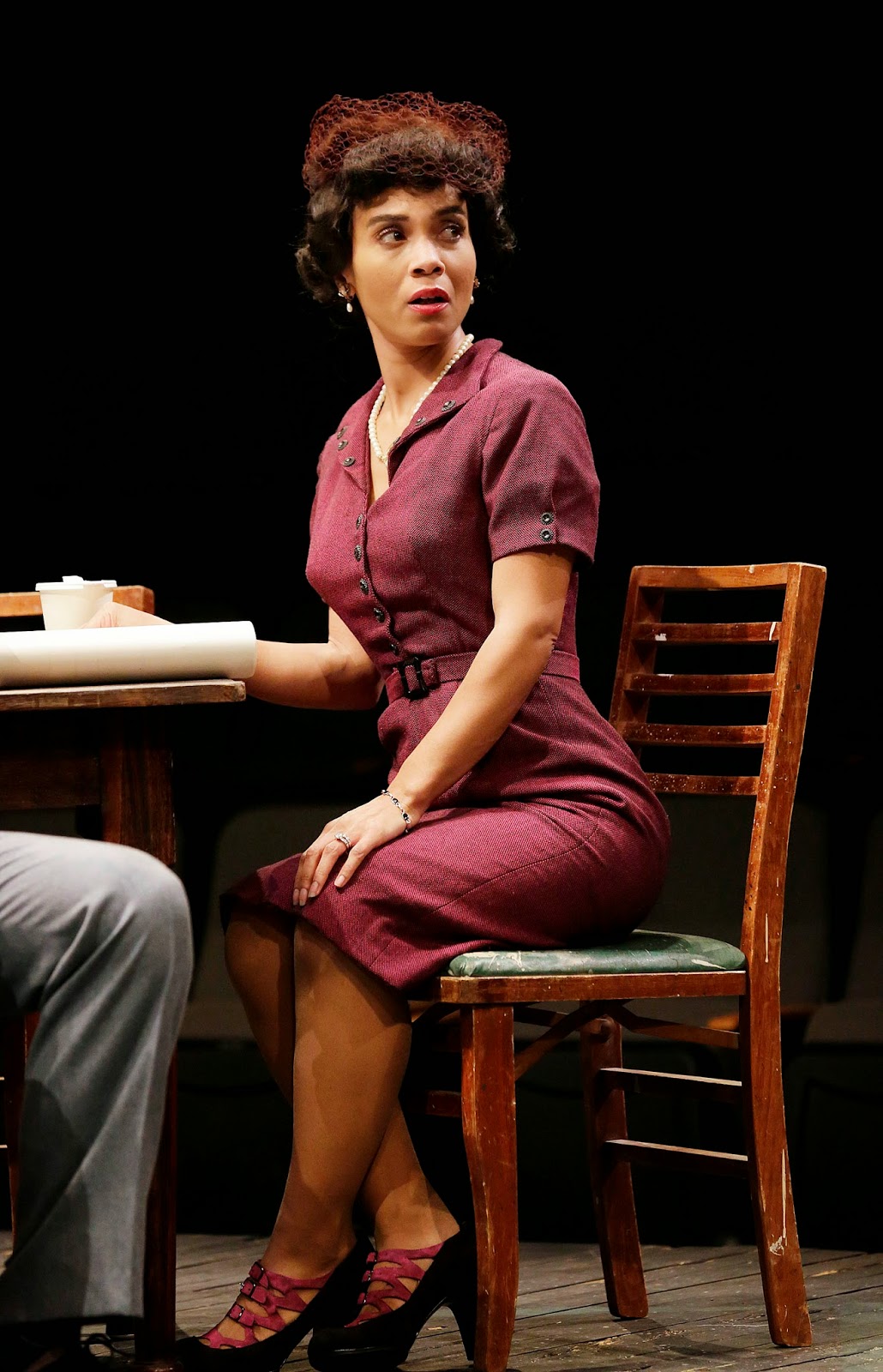
Karen Perry's Midcentury Fashion for Trouble in Mind

Suzette Azariah Gunn as Millie.
Photo by Jon Gardiner
Given Trouble in Mind's relevance to current issues today, its points prove more striking when we are reminded that it was written, and takes place in, the 1950s. Perhaps no element conveys the mid-century period more strongly and beautifully than Karen Perry's costume design.

This is not Karen's first time working on Trouble in Mind. She, director Jade King Carroll and set designer Alexis Distler collaborated on a production at Two River Theater in New Jersey last spring, which also starred Roger Robinson as Sheldon Forrester. Karen and Jade came to discover this forgotten gem of a play through a project called 1Voice, 1Play, 1Day. The event organizes black theatres around the country to stage a reading of the same play on the same day to bring solidarity and celebrate African American theatre. Karen saw a reading of Trouble in Mind in Los Angeles at the same time that Jade saw it read in New York. It also happens that our own Kathy A. Perkins saw it the same day in Chicago. Karen and Kathy both credit 1Voice for the rebirth Alice Childress' masterpiece has seen in the last few years. There is no doubt that it led to our own production since Jade and Karen immediately knew they wanted to produce the play together, and Kathy knew PlayMakers needed to bring the show here.

Despite having designed for Trouble in Mind before, Karen's costumes for our production have their own unique look. When Karen begins her concepts, she designs only the shape and style of the costumes in advance. The fabrics are selected later on in the process, and she lets the materials decide the colors and details for each unique costume.

Below you can view her original renderings and see how they come to life on our stage.

Karen Perry's design for Wiletta Mayer, as worn by Kathryn Hunter-Williams. Photo by Jon Gardiner.
Karen Perry's design for Al Manners, as worn by Schuyler Scott Mastain. Photo by Jon Gardiner.
Karen Perry's design for Millie Davis, as worn by Suzette Azariah Gunn. Photo by Jon Gardiner.
Karen Perry's design for Sheldon Forrester, as worn by Roger Robinson. Photo by Jon Gardiner.
Karen Perry's design for John Nevins, as worn by Myles Bullock. Photo by Jon Gardiner.
Karen Perry's design for Judy Sears, as worn by Carey Cox. Photo by Jon Gardiner.
Karen Perry's design for Bill O'Wray, as worn by Jeffrey Blair Cornell. Photo by Jon Gardiner.
Karen Perry's design for Henry, as worn by David Adamson. Photo by Jon Gardiner.
Karen Perry's design for Eddie Fenton, as worn by Jorge Donoso. Photo by Jon Gardiner.

Trouble in Mind is onstage through February 8. Click here to buy your tickets now!

Monday, January 26, 2015

Kathy A. Perkins: Shining a Light on Trouble in Mind

Kathryn Hunter-Williams as Wiletta
Photo by Jon Gardiner

We've been very excited about our production of Alice Childress' Trouble in Mind, but perhaps none more so than company member Kathy A. Perkins. She is lighting designer for the show, but her connection is also personal. In 1984, she was asked to design for the premiere of Childress' Gullah at Third World Theater in Amherst, Massachusetts.

Kathy worked closely with Childress, and their collaboration grew into friendship. Kathy considers her a mentor, and you can still hear the admiration in her voice when she speaks of her. "I knew her the last ten years of her life. She was an amazing woman. Very passionate about what she did."

Alice Childress working on Gullah at Third World Theater in 1984. Photo courtesy of Kathy A. Perkins.

Childress' life was political, and it was reflected in her work. She wrote about strong women with integrity who were not afraid to speak up even when there was a cost. Kathy elaborates,
The women she wrote were so outspoken that they sacrificed financial gain or work, which was what Alice Childress was about. She suffered financially because she refused to compromise when it came to her work. She was a good person of incredible integrity and principles. She believed in what she wrote. She'd say, "This is the story I want to tell, if you're not interested in this story, then go somewhere else." 
We learned in our earlier posts by Mark Perry about how true this was, especially relating to Trouble in Mind. If you think that the political issues of the story are ones specific to the 1950s when the play was written, think again. "It is so timely," Kathy states. "Even though this play was written 60 years ago, everything she's talking about is still happening." She talks of her experience as an African-American woman in the theatre.
There are so few plays being produced by black women in the major theatres, and there are even fewer black women directing. The trend is usually a lot of black plays are being directed by white directors. I'm not saying they shouldn't, but I'm saying where do black women go to direct? Are they being allowed to direct a white play? I have to remind theatre companies that I have the same MFA in lighting that my white collegues have. I can do Shakespeare. You don't have to call me just for "the black show." So, in a sense, things haven't really changed.
Alice Childress working on Gullah at Third World Theater in 1984. Photo courtesy of Kathy A. Perkins.
Kathy's approach to each project varies from show to show, but the work that Kathy has created on our stage for this production is particularly inspired. She says she drew from "the spirit of Alice Childress" and designed how she expects she would have wanted the stage to look. Childress was into realism with as little distraction as possible. Kathy captures the dinginess of backstage work lights, finding sepia colors to add a vintage quality of the era. The lights get brighter as the show builds, going from warm to cool hues, paralleling the tension of the play.

One of the most poignant moments of the play is delivered by Roger Robinson as Sheldon describing a disturbing event from his past. You will see for yourself Kathy's hand in the scene and just how integral her design work is to this piece.
Jorge Donoso, Carey Cox, Roger Robinson, Suzette Azariah Gunn and Schuyler Scott Mastain. Photo by Jon Gardiner.

Trouble in Mind is onstage through February 8. Click here and buy your tickets now.