Showing posts with label Costumes. Show all posts

Friday, December 4, 2015

Creating a Starcatching Color Palette for Peter

Rachel Pollock at work
"A show like Peter and the Starcatcher has an incredibly specific color palette, which means that we moved a lot of projects through the dye shop for this production," says costume craftsperson Rachel Pollock.

Rachel was painter/dyer for the individual parts of each of the many costumes worn by thirteen actors portraying over 100 characters, while her co-craftsperson, third year graduate student Erin Abbenante, made many of the hats and headdresses. Together they served as a craftwork team of two, coordinating with the main costume shop team, comprised of many more costumers (both staff and students),  working as tailors, drapers, stitchers and more. 

In addition to handling yards and yards of fabric, this included work with vintage lace trim, buttons and elastic for suspenders. Mermaid costumes for one show-stopping production number alone required over thirty dye jobs for everything from zippers to satin gloves.

The brocade vest for  pirate chief Black Stache embellished with applique dragon motif and hand painted designs. And to the right, as worn by Mitchell Jarvis playing the dastardly dandy (photo by Jon Gardiner.)
The Ensemble struts their stuff  as musical mermaids. (Photo by Curtis Brown.)
The collar for warrior chieftain Fighting Prawn, ornamented with rooster tail feathers and hand-painted cutlery. And as worn by Myles Bullock (center front) with the Ensemble. (Photo by Curtis Brown),

"When you look at the array of clothes for this show, an incredible amount of labor has gone into creating the effects the audience enjoy during the course of this fast-paced 2-hour performance. Even someone paying close attention to the biggest, showiest costumes will have little idea of the time, effort and attention to detail required," says Rachel.

Enjoy the many colors of Peter and the Starcatcher. Onstage now through December 12.

Click here or call our Box Office 919-962-7529 for tickets.

Monday, November 30, 2015

Holly Poe Durbin's Costumes Bring Magic to Life

In our last post, Holly Poe Durbin described her design process from research to working with the costume team. Now, take a look as her creations are brought to life in our production of Peter and the Starcatcher.

Holly's design for Black Stache, as worn by Michell Jarvis.
Photo by Jon Gardiner.

Holly's design for Lord Aster, as worn by Ray Dooley.
Photo by Jon Gardiner.

Holly's design for the Mollusks, worn by (L to R) John Allore, Myles Bullock, Schuyler Scott Mastain, Jeffrey Blair Cornell, William Hughes. Photo by Curtis Brown.

Holly's design for the Orphans, Ted, Prentiss and Peter, as worn by (L to R)
Evan Johnson, Daniel Bailin, and Jorge Donoso. Photo by Curtis Brown.

Holly's design for Slank, as worn by John Allore.
Photo by Curtis Brown.


Experience Peter and the Starcatcher! Onstage now through December 12.

Click here or call our Box Office 919-962-7529 for tickets.

Monday, November 23, 2015

Holly Poe Durbin: Creating Costumes for Peter and the Starcatcher

Centered around pirates and magic, Peter and the Starcatcher is a fast-paced production, giving actors the joy, and responsibility, of alternating rapidly between multiple characters. While some characters need little or no physical change, others require complete transformation. "This type of play is very much like doing a musical—once the music starts there’s little room for variation. The entire design team must create a world for the play that will enhance speed and fluidity," explains costume designer Holly Poe Durbin.

Holly says her start, working on ensemble pieces for the pre-Broadway production of Angels in America and an early version of The Kentucky Cycle, taught her about story structure and dramatic intent, which helped with this production.
The design process starts before the roles are even cast. "The director (Brendon Fox), actors and costume designer collaborate to make the thousand small decisions that bring each character to life," says Holly.  She starts by sorting through which characters are fully formed and dynamic, and which are portrayed in a partial way as fleeting momentary characters.

The design team spent hours creating a storyboard for the show with Brendon.
"Together we started forming rules about the world such as equating "star stuff," a magical substance, with light. Any character encountering it will have shiny surfaces or light qualities to their costumes. Another rule we established is identifying each moment by interpreting whose point of view we are seeing through."
After discussing these things at length with the entire team, Holly was able to put pencil to paper and begin to actually design the costumes. Her design process is broken into three steps. Holly began by doing a lot of research, which included reading the Peter and the Starcatchers books and the original Peter Pan stories. She collected images that inspire her, then curated those images into mood boards for specific characters.
Research mood boards for Black Stache and pirate costume details.

Then, Holly created pencil sketches used to bounce ideas around with Brendon. In some cases the sketches changed several times, as artists changed their ideas and Holly redesigned the characters. This phase wrapped up when casting began so Holly could work with each actor's approach and add it into the mix.

The final step was when sketches went to the PlayMakers costume shop for brainstorming with the costume team. At this stage, Holly worked with the team to solve any challenges that arose.
"It takes a large pool of specialists to create a show like Peter. PlayMakers has a spectacular reputation for being able to create a top notch stage vision and I was very excited to know I was coming here to do Peter and the Starcatcher."
Come and enjoy Peter and the Starcatcher. Onstage through December 12.

For tickets, click here or call our Box Office at 919-962-7529.

Friday, October 16, 2015

Jade Bettin Brings New York Style to Seminar


In our last post, PlayMakers resident costume designer Jade Bettin (A Midsummer Night’s Dream, The Tempest, Metamorphoses, Clybourne Park, Mary’s Wedding) described the influences that inspired her in creating clothes for Leonard and the young writers-in-progress in Seminar.

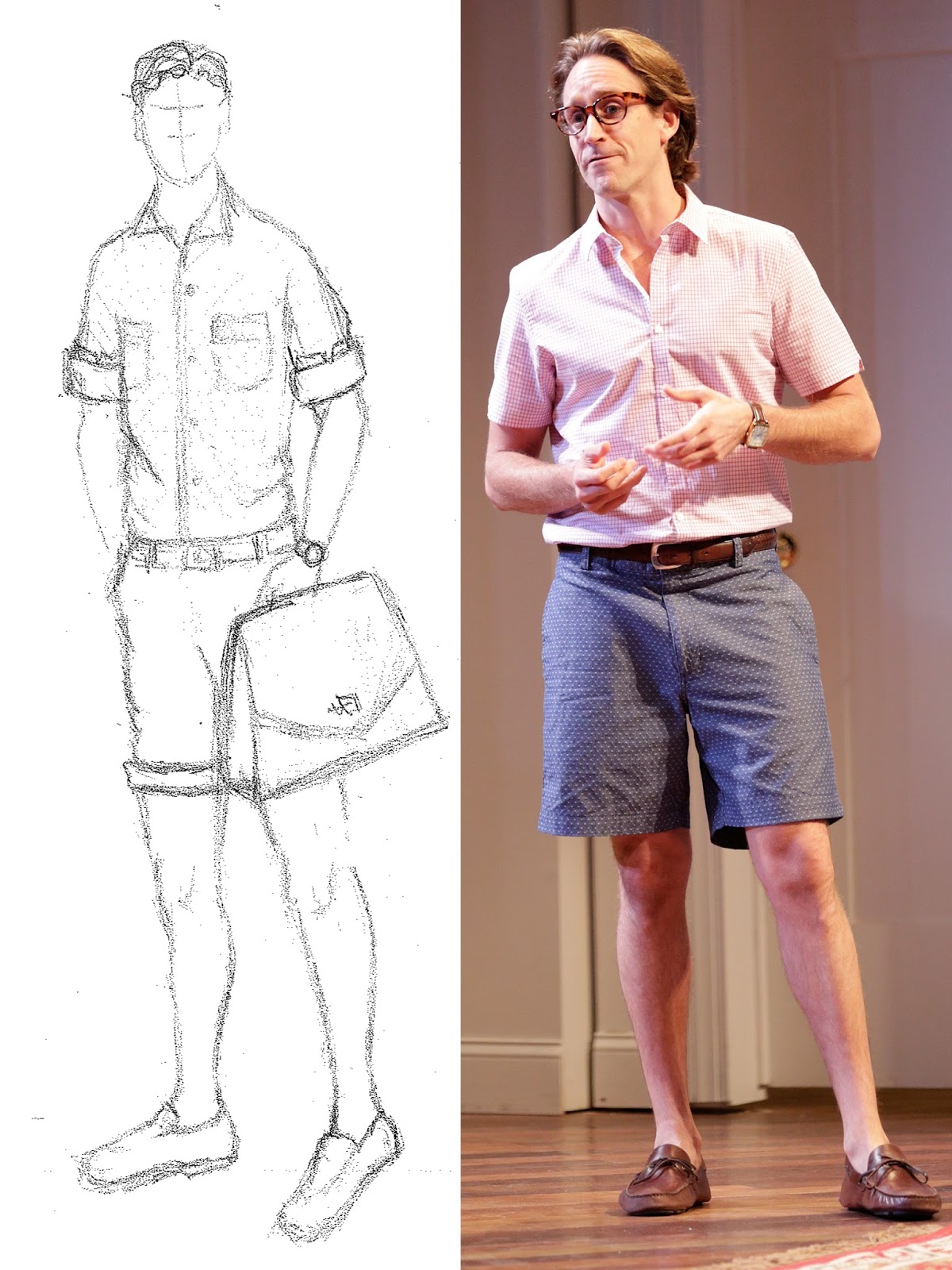
Now take a look at some of Jade’s sketches for her New York-inspired designs paired with snapshots of how they “come to life” in the production onstage.

Jade's design for Douglas, as worn by
Schuyler Scott Mastain. Photo by Jon Gardiner
Jade's design for Izzy, as worn by Allison Altman.
Photo by Jon Gardiner.

Jade's design for Leonard, as worn by Ray Dooley.
Photo by Jon Gardiner
Jade's design for Kate, as worn by Carey Cox.
Photo by Jon Gardiner.
Jade's design for Martin, as worn by Myles Bullock.
Photo by Jon Gardiner.

Join us and see how clothing contributes to the characterizations in Seminar. Onstage now through November 1st.

For tickets, Click Here or call the Box Office at 919-962-7529.

Wednesday, October 14, 2015

Presenting Identity Through Clothing in Seminar

by Jade Bettin

Costume sketch by Jade Bettin
When approaching the costume design for a play set in modern day New York City, it might seem surprising that it was the words of an ancient Greek man that would catch my attention and so perfectly capture the sentiment I was aiming for: “Know first who you are; and then adorn yourself accordingly” (Epicetus 44-135 AD). Of course this has resonance because it applies just as much to the way we approach dress today as it did then.

In Seminar, we have four young men and women, all of whom are very hopeful that their writing career is about to take off as a result of mentoring from the successful editor/writer they have hired to examine and critique their work. The students are all from different socioeconomic backgrounds, but they have in common the fact that they are all on the verge of something – they are in a state of transition and trying to find out who they are as writers and, most likely, also as individuals. My goal is to capture that state of flux in their clothes as they try to sort out who they are.

Kate's clothing
To go back to Epicetus’ quote, because these students are still figuring out who they are, what they present of themselves through their clothing are works in progress. So, what messages are their clothes sending and what does it reveal about them in that moment? Each of these students bravely presents their written work to Leonard and it is clear after his critique of Kate’s story in the second scene that they are going to get the brutal truth. And so they are arming themselves for these encounters; putting their best foot forward as we might do for an important interview or date. They are largely doing that with the clothes they wear. For Kate, it’s about putting on her best dress and curling her hair just so. For Douglas, it’s about the costume he imagines a successful writer would wear. This is not necessarily their true selves, but their best selves, or in some cases, the selves they hope they become as a result of these seminar sessions.


I am fortunate in that I get to tell this story of the characters’ identity over the course of the play as there are nine scenes and in nearly every scene the characters wear different clothes. For instance, I am able to explore the fallout of Leonard’s critique on Kate through her clothing. The clothes she wears in the middle section of the play are probably a closer reflection of who Kate actually is at that moment. Just as she needs Leonard to challenge her writing and jar her out of complacency, she needs those revelations about self so that she can discover who she is and dress accordingly.

Join us to see how these young writers evolve, as Seminar takes the stage tonight through November 1st.

Click here or call our Box Office at 919-962-7529 for tickets.

Thursday, April 30, 2015

Dreaming in Vivid Detail: Jade Bettin's Design for Mary's Wedding

In Stephen Massicotte's Mary's Wedding we follow Mary and Charlie through a dream sequence the night before Mary is supposed to get married. Costume designer, Jade Bettin's, research coupled with her evident passion for the play have produced designs that are detailed and multifaceted. They create a canvas for actors Carey Cox and Myles Bullock to paint their poignant story.

Because the play takes place during a dream, Jade explains that the clothing must be bound in reality, but that there is some leniency. Mary is seen in a white lace nightgown, but Jade explained that the time period worked to her advantage. Many dresses in the 1910s worn during the day were similar to nightgowns. Women sported dresses that looked similar to modern lingerie with a great deal of lace detailing.

The dress worn by Mary is quite personal to Jade. Her interest in costume design was sparked by her mother. Her mother was a seamstress and Jade said she received her first sewing machine when she was in 5th grade. She remembers spending hours sewing together. Since her mother's passing eight
Jade's final rendering.
years ago, Jade puts elements of her mother onstage in the clothes she designs. All of the fabrics, laces, and trims of Mary's dress belonged to Jade's mother, making this design a very special one.

Jade has a deep interest in the intersection between fashion and history. Her extensive research of images can be seen on her Pinterest board here. It's filled with landscapes of Canada and France, images of silky white lace dresses, and clothing worn by cavalry men.

Charlie's costume had to serve multiple functions. Charlie works on a farm and rides horses, so he is seen in a neutral button up shirt, riding pants, and lace-up boots. Jade ensured that elements of his costume would also fit in a battlefield setting with details like his stand collar. Small details such as this indicate a change in character onstage. 

See Jade's personal, adaptive designs for Mary's Wedding onstage April 29th to May 3rd!

Click here for more information or call our box office at 919.962.7529.

Tuesday, April 21, 2015

Director Cody Nickell on imagining his "dream play," Mary's Wedding


In Mary's Wedding by Stephen Massicotte, two actors come together to create a dream sequence taking us through horse rides, battle scenes and tea parties that ultimately lead to the blossoming of their love. The character Charlie first addresses the audience and makes it perfectly clear that the events to follow are part of a dream. "I ask you to remember that," he says. Director Cody Nickell says the dreamlike setting allows the production to break all rules of time, space, and at times, even character.

Cody had many difficult questions to answer at the start of the production process. The dream moves from place to place quickly, leaving complicated theatrical elements for Cody to consider. While some may see these questions as challenges, Cody chooses to see them as gifts.
"How do you bring to life a horse for a cavalry charge when there is no horse? How do you show a moonlit battle between trenches on the front lines of World War I with only two actors? And maybe most interesting, for all its theatricality, how do you show the simple story at the heart of this play about two young people falling in love?"
While the staging can be difficult, the underlying story of Mary's Wedding is much simpler. It follows the relationship of two young people in love and the Great War that comes between them. To escape a thunderstorm, Charlie, played by Myles Bullock, and Mary, played by Carey Cox, seek shelter in an old barn. In this setting, their vulnerabilities are exposed and we see sparks of love develop between them almost immediately. The audience follows their budding romance, and ultimately, their separation when Charlie is taken off to war.
"It begins at the end and ends at the beginning. There are sad parts. Don’t let that stop you from dreaming it too. " - Charlie, in his first monologue from Mary's Wedding.
The many imaginative gifts the production staff conjures will awaken the imaginations of audience members as well. "This engagement of audience imagination makes the experience active for them, not passive; they become witnesses, not just observers," says Cody. The actors are on a journey, but they invite the audience along to experience the terror and the hope that Charlie and Mary encounter.

Jeff Adelberg's mystic skyscapes and lighting will be a key factor in the quickly changing time, place and mood of the dream sequence. And Cody says costume designer Jade Bettin took initial costume ideas and ran with them, doing spectacular research and paying attention to details that further conceptualize the journey both the actors and audience traverse. Jeff's lighting paired with Jade's period costumes will pique imaginations and transform the stage from a physical space, to a fantastical world with no limits.

Cody says he's thrilled to collaborate with scenic designer Daniel Conway once again. Daniel's set has a circular frame creating a portal through which the audience views the story. This portal takes us from Canadian plains to European battlefields on a dynamic set that will evoke the many settings explored by the young lovers.

Experience the dream of Mary's Wedding with us April 29th to May 3rd!

Click here for more information or call our box office at 919.962.7529.

Wednesday, April 15, 2015

Wardrobes that span decades in 4000 Miles

In Amy Herzog's play 4000 Miles, life unexpectedly throws Leo and Vera together. They are drastically different, with Leo in biking attire and casual jeans and Vera in the effortless wardrobe she's collected throughout her time living in the West Village of New York City. Costume designer Jan Chambers has crafted distinct ensembles that reflect the unique lives of the play's characters.

Vera's closet is full of items she's collected over the years. She's lived in the same apartment since the 1950s, so her wardrobe is as eclectic as the fashion trends of the decades Vera has experienced. Vera dresses comfortably, but Jan made sure she has some pizazz. Jan says, "Vera is not your Midwestern grandmother." Because she has a visitor, she is dressing up more than usual. Vera also attends two funerals during the play, but Jan said she wears a lot of black anyway. "She's a New Yorker," Jan explains. 

Costuming Leo proved to be a challenge, as he's been on a 4000 mile bicycling trip from Seattle to New York. When he arrives at Vera's door, the only clothes he has are the items he could carry in a bag. His wardrobe is that of an unrestricted nomad on a bicycle, including jeans, a rain jacket, a V-neck sweater, and other casual clothing he could bring from place to place.

Amanda, played by Sehee Lee, is an art student Leo brings home one night. Jan said she and director Desdemona Chiang really enjoyed putting her outfit together. Amanda wears platform shoes, fishnet tights, purple streaks in her hair, and a coral leather jacket. She's young, quirky, and has the edginess of a New York City art student.

See Jan's costume renderings come to life below! 

Jan's design for Leo, as worn by Schuyler Scott Mastain. Photo by Curtis Brown.
Jan's design for Vera, as worn by Dee Maaske. Photo by Jon Gardiner.
Jan's design for Bec, as worn by Arielle Yoder. Photo by Jon Gardiner.
Jan's design for Leo, as worn by Schuyler Scott Mastain. Photo by Curtis Brown.

Jan's design for Vera, as worn by Dee Maaske. Photo by Jon Gardiner.

Jan's design for Amanda, as worn by Sehee Lee. Photo by Jon Gardiner.
Jan's design for Vera, as worn by Dee Maaske. Photo by Curtis Brown.


Jan's design for Leo, as worn by Schuyler Scott Mastain. Photo by Jon Gardiner.


See Jan Chambers' designs onstage in 4000 Miles through April 19th!

Click here for more info or call our box office at 919.962.7529.

Tuesday, March 31, 2015

Reflecting the Richness of Vera's Life: Jan Chamber's Scenic Design for 4000 Miles

Preliminary sketch by scenic designer Jan Chambers.
4000 Miles takes place in Vera Joseph's apartment in the West Village of New York City. Vera is 91 years old and has lived in the same apartment since the 1950s. Vera has lived a rich, vibrant life, so it only makes sense that her living space should reflect the adventures she's been on, relationships she's had, and experiences she's been through. This was the challenge of scenic and costume designer Jan Chambers.

Jan explains that over the years, Vera, played by Dee Maaske, has collected pieces that represent her fascinating life. Jan calls Vera's decorating style "intellectual bohemian," as there is no defining color scheme, however an abundance of photos, posters, furniture, and knickknacks give us a feel for Vera's passions and her extensive life experience.
"She's not a fancy person, but she's elegant in her own way."
Scenic model by Jan Chambers.
Jan says that in order to create a believable living space for Vera, she envisioned the spaces of some friends and relatives. "I am definitely channeling people I've known." The landlords of a friend in New York have lived there for decades. One is an artist and the other, a psychologist. Their apartment is filled with eclectic items representing their respective fields and passions, leaving no wall uncovered. It has a thrift shopper appeal that Jan was looking to create in Vera's apartment.

Vera's apartment may seem cluttered, but Jan explains that Vera knows exactly where everything is. She says Vera has fallen into a routine. "She probably eats the same thing for breakfast everyday." Vera's apartment has not changed much over the years, and Jan's design reflects the living space of an older character who has fallen into a pattern, but retains her vibrancy. 
Visual inspiration for Vera's apartment.

Stage left and upstage, you'll notice model cars and airplanes. These are placed intentionally as they remind us of Vera's late second husband, Joe. Although Joe died 10 years prior, he and Vera traveled together and shared the same political beliefs, thus the books about Marxism on the shelves and in baskets, and posters of Cuba and Mexico. Jan explains,"The more masculine sense given by the model cars and airplanes lets us remember that Joe is still with us in some way." 

Jan also loves that 4000 Miles is a story of a grandmother and grandson. "I'm making my son bring his grandmother as a date!"

We invite audience members, young and old, to enjoy 4000 Miles with us as this wonderful dramatic comedy opens Wednesday evening.

4000 Miles opens April 1st and runs until April 19th. 

Click here for more info or call our box office at 919-962-PLAY (7529)

Monday, March 23, 2015

Desdemona Chiang on bridging generational gaps in 4000 Miles

Director, Desdemona Chiang.
At first, Leo and Vera seem to be an unlikely pair. Leo is 21-years-old, while Vera stands at 91 years young. Leo enjoys riding his bike cross-country, while Vera calls her neighbor daily to assure her she's still alive. Vera, played by Dee Maaske, is Leo's grandmother, but much time has passed since they last saw one another. After a heart-shattering loss, Leo, played by Schuyler Scott Mastain, shows up at Vera's door. His original plan to stay for one night turns into three weeks and a once improbable duo end up finding solace in one another.

Director, Desdemona Chiang, said she wanted to direct 4000 Miles because she loves plays that "explore family dynamics and human relationships." She definitely got what she bargained for with Leo and Vera. With two distinct characters lacking similarity at first, Desdemona wants the emphasis of the play to be placed on the fully developed relationship between Vera and Leo. She says it is the intricate moments between them that make 4000 Miles "both ordinary and utterly exceptional."
"It is a sweet, funny, and poignant story of two people who, as a result of an unexpected tragedy, find themselves connected and changed forever. "
Desdemona wants to ensure that the audience doesn't see Vera for her age, but for her vigor. She appreciates 4000 Miles for placing a character of Vera's age in a prominent role. Desdemona explains, "Americans are notoriously ageist—we usually regard the elderly as a social inconvenience and the discussion of death and dying to be uncomfortable, so oftentimes this particular demographic of people goes socially unacknowledged and ignored. It’s so satisfying to be working on a play that puts a 91 year-old woman at the center of the story." She said Vera reminds her of her own feisty, sharp, unapologetic grandmother.

Costume designs, by Jan Chambers, will be contemporary and will provide further insight into the
contrasts between Leo and Vera. As a twenty-something "neo-hippie," Leo will be dressed in either casual jeans and sweatshirts, or bicyclist attire. Vera will be dressed in flowing, comfortable pieces to reflect the routine she has fallen into.

Commerce Street in the West Village.
The play is set in Vera's apartment in Manhattan's West Village. Desdemona explains that she and scenic designer, Jan Chambers, sought to create an environment that told the story of Vera's everyday life before Leo showed up on her doorstep. She explains, "The placement of furniture, books, dishes,and other household items are very deliberate, and speak volumes about the kinds of life patterns she has developed over the years, and how that pattern gets disrupted (in both good and bad ways) when Leo arrives."

The mood onstage will be set by lighting designer, Xavier Pierce. Desdemona said they will utilize the lighting to "establish rhythms and the storytelling inside transitions in between scenes." Desk and floor lamps will contribute to the sense of intimacy between the characters.

4000 Miles has been challenging at times for Desdemona because she wants to maintain the beautiful simplicity of the relationship between Leo and Vera . She explained that in our current theatrical world, it can be tempting to create the "the bright flashy thing, the big social statement, or the jazz hands dance number," but that in 4000 Miles, the nuanced, fully-developed relationship matters most.
"This is play that doesn’t set out to change the world, yet the worlds of these two individuals are irrevocably changed."
What's Desdemona's goal? She said, "My hope is that by the end of the show, audience members will be gathered in the lobby calling their grandmothers or their grandchildren."

We invite you to experience the refreshingly honest, 4000 Miles, onstage April 1-19!

Click here for more info or call our box office at 919.962.PLAY (7529).

Friday, March 6, 2015

Patrick Holt's Brilliant Renderings and Costume Concepts Come to Life

Patrick Holt is renowned for his stunning, detailed costume renderings, as pictured below. His costume designs for An Enemy of the People encapsulate the 1950s era of fedoras, tailored suits, and feminine, pastel skirts. Limited to the subdued colors worn by business men of the 1950s, Patrick's palette was more muted, but one character needed to stand out.

Patrick's inspiration behind Peter Stockmann's flair, as worn by Anthony Newfield. Photo by Jon Gardiner.
Peter Stockmann, the Mayor, needed to exude a certain importance, explains Rachel Pollock, costume craftsperson. She said the design team received an email from director Tom Quaintance stating, "The Mayor's hat needs to clearly be the Mayor's hat." She and Patrick jumped into action, finding exactly the right details to complete Peter's ensemble. They searched for a way to ensure Peter would stand out, but it had to be subtle. "We needed some way to set it apart him an official capacity that wouldn't be cartoonish or absurd," said Rachel. Patrick and Rachel chose from a collection of unique feather ornaments to make Peter's costume flourish. This subtle detail proves effective, along with the touch of red, to evoke a sense of authority, wealth, and importance in Peter Stockmann's character.

The concept of water is prevalent throughout the plot, as well as the design concepts. The designs for dresses worn in the second act by Petra and Catherine Stockmann use teals and dim browns evoking the polluted springs that drive the plot, Rachel explained.
"It's a visual representation of the taint in the water."
With water being a common theme throughout the play, it's no wonder Patrick was inspired to create visual representations of the contaminated spring in his designs for the Stockmann women.
Patrick's rendering for Catherine Stockmann as worn by Julia Gibson. Photo by Jon Gardiner.
Patrick's rendering for Petra Stockmann as worn by Allison Altman. Photo by Curtis Brown.
For the angry mob scene in which Dr. Stockmann is pelted with water, precautions had to be taken. Rachel says they spent time Scotch Guarding the costumes they expected to be exposed to the most moisture. However, this was not Rachel's first time working around water in a production. After the 4,500 gallon pool used in PlayMakers' 2014 production of Metamorphoses, she had more than enough skill and experience to collaborate on the challenge of costumes getting soaked throughout the show.

The mob throwing water at the face of Dr. Stockmann. Photo by Jon Gardiner.


We are pleased to have Patrick Holt's costume designs featured in another production at PlayMakers. He served as costume craftsperson for PlayMakers early on in his career. Rachel said Patrick's past experience with PlayMakers simplified the process for the collaborative costume team. "He ran this dye shop. So he is very familiar with this facility and what it can do."

Patrick's rendering of Dr. Stockmann's costume worn by Michael Bryan French. Photo by Curtis Brown.

See Patrick Holt's beautiful renderings come to life onstage. Book your tickets for An Enemy of the People - onstage through March 15!

Click here to buy tickets or for more info or call our box office at 919.962.7529.

Friday, February 20, 2015

Director Tom Quaintance on creating a true "Enemy of the People"

Tom Quaintance, director
Although An Enemy of the People was written by Henrik Ibsen in 1882 and adapted by Arthur Miller in the 1950s, director Tom Quaintance believes it is as relevant today as it was for those eras. With characters that grapple with corruption, the influence of money, and the power of the media to shape public opinion, Tom says this play "feels like it could have been written yesterday."

The plot follows Dr. Stockmann, played by Michael Bryan French, who tries to alert citizens when he discovers an underwater spring feeding the successful town spa is threatened by toxic waste poisoning. His brother Peter, played by Anthony Newfield, serves as Chairman of the Board of the spa. He works against his brother, feeling it's in the town's best interest to conceal Dr. Stockmann's findings.

In our current age of leaders with questionable ethics, nonstop surveillance, and unverified media sources, the story of Dr. Stockmann could not be more pertinent. Tom explains:
"It is the story of science versus politics. It is the story of a whistleblower. It is the story of how money influences everything. It is the story of how the media shapes how we view the world. In today’s increasingly divided society, where people increasingly only hear the news and the spin they want to hear, it is an important play."
With the show holding many themes, Tom has collaborated with scenic designer McKay Coble and costume designer Patrick Holt to create a production that evokes the truth and realism Arthur Miller sought to portray when adapting the play.
McKay Coble's scenic design model

Tom describes the costumes as extraordinary. He says Patrick's "control of the color palette and specificity of cut and style tell each character’s story."

McKay's detail-oriented design complements the natural exchanges of the dialogue and allows the actors to discover their own truths within the space. Tom calls it, "both strikingly realistic and beautifully abstract."

Although the play is set in the 1950s, the scenic design utilizes a surrounding water feature inspired by a modern treatment plant. This is purposeful, "to invite the audience to consider the contemporary relevance of the play."

Bottom line: Tom believes An Enemy of the People is timeless and "a critical play for 2015."

An Enemy of the People is onstage February 25-March 15. Do not miss this critical play!

Click here for more info or call our box office at 919.962.PLAY (7529).

Monday, February 2, 2015

Karen Perry's Midcentury Fashion for Trouble in Mind

Suzette Azariah Gunn as Millie.
Photo by Jon Gardiner
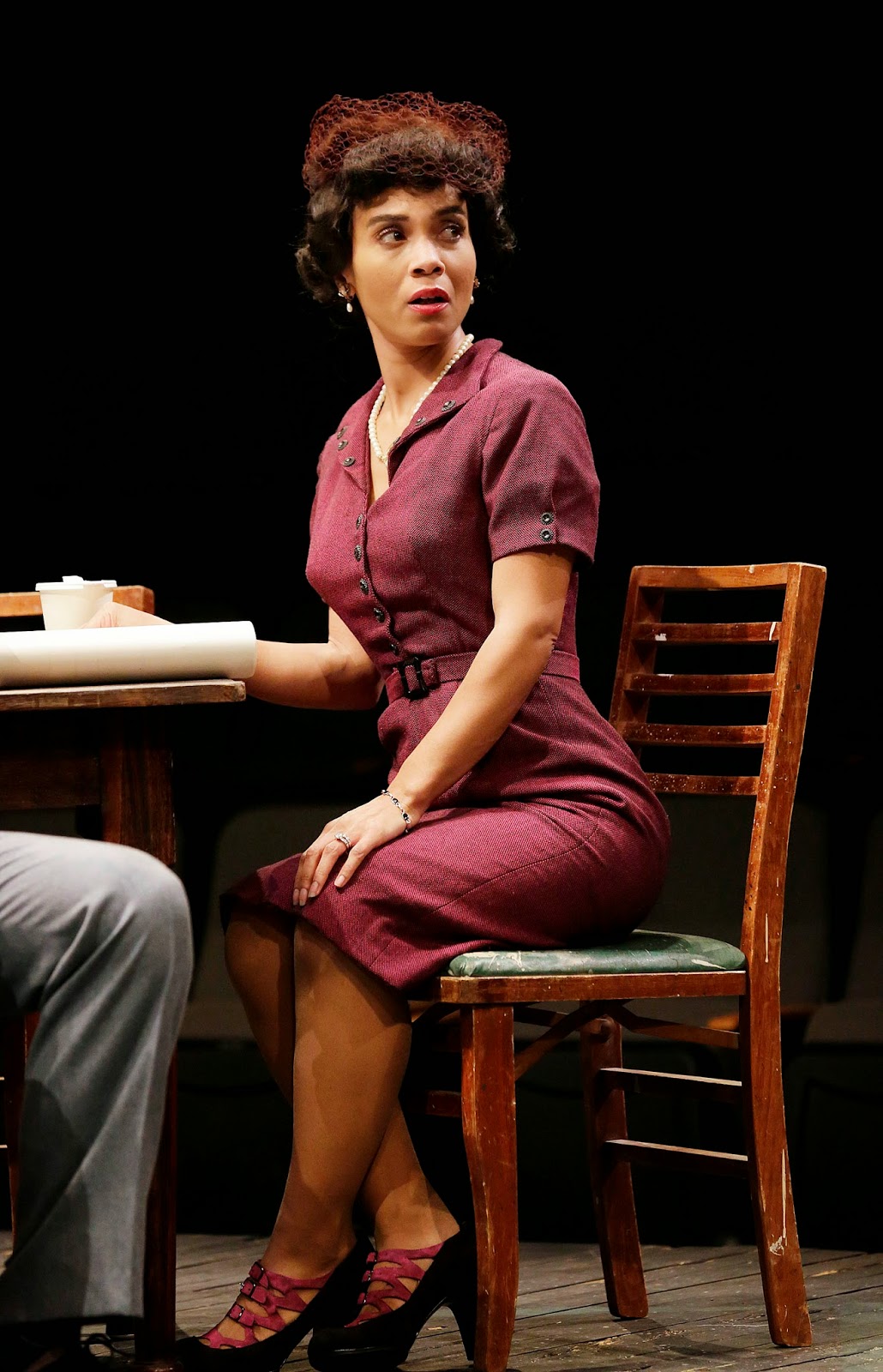
Given Trouble in Mind's relevance to current issues today, its points prove more striking when we are reminded that it was written, and takes place in, the 1950s. Perhaps no element conveys the mid-century period more strongly and beautifully than Karen Perry's costume design.

This is not Karen's first time working on Trouble in Mind. She, director Jade King Carroll and set designer Alexis Distler collaborated on a production at Two River Theater in New Jersey last spring, which also starred Roger Robinson as Sheldon Forrester. Karen and Jade came to discover this forgotten gem of a play through a project called 1Voice, 1Play, 1Day. The event organizes black theatres around the country to stage a reading of the same play on the same day to bring solidarity and celebrate African American theatre. Karen saw a reading of Trouble in Mind in Los Angeles at the same time that Jade saw it read in New York. It also happens that our own Kathy A. Perkins saw it the same day in Chicago. Karen and Kathy both credit 1Voice for the rebirth Alice Childress' masterpiece has seen in the last few years. There is no doubt that it led to our own production since Jade and Karen immediately knew they wanted to produce the play together, and Kathy knew PlayMakers needed to bring the show here.

Despite having designed for Trouble in Mind before, Karen's costumes for our production have their own unique look. When Karen begins her concepts, she designs only the shape and style of the costumes in advance. The fabrics are selected later on in the process, and she lets the materials decide the colors and details for each unique costume.

Below you can view her original renderings and see how they come to life on our stage.

Karen Perry's design for Wiletta Mayer, as worn by Kathryn Hunter-Williams. Photo by Jon Gardiner.
Karen Perry's design for Al Manners, as worn by Schuyler Scott Mastain. Photo by Jon Gardiner.
Karen Perry's design for Millie Davis, as worn by Suzette Azariah Gunn. Photo by Jon Gardiner.
Karen Perry's design for Sheldon Forrester, as worn by Roger Robinson. Photo by Jon Gardiner.
Karen Perry's design for John Nevins, as worn by Myles Bullock. Photo by Jon Gardiner.
Karen Perry's design for Judy Sears, as worn by Carey Cox. Photo by Jon Gardiner.
Karen Perry's design for Bill O'Wray, as worn by Jeffrey Blair Cornell. Photo by Jon Gardiner.
Karen Perry's design for Henry, as worn by David Adamson. Photo by Jon Gardiner.
Karen Perry's design for Eddie Fenton, as worn by Jorge Donoso. Photo by Jon Gardiner.

Trouble in Mind is onstage through February 8. Click here to buy your tickets now!